online marketing
Best thoughts And Stories
Ads
online marketing
Saturday, March 30, 2013
Rabindranath Tagore
Even though, he was most famous as a poet, he was also an artist, novelist, playwright, philosopher and freedom fighter. Or simply, the writer of songs filled
with love
. His poetry covered a vast range of topics from nature to patriotism.
Early Life
Born on 8th May 1861 in Calcutta to Maharishi Devendranath, who himself came from a family of nobility, he was the youngest of 14 children. The family was addressed by the honourable title 'Thakur' which was later changed to
Tagore
.
His mother Sharadadevi expired when he was still young, and his father rarely spent much quality time with him. As a result he grew up extremely sensitive and non - conventional. He could not tolerate any kind of authority, and so, his schooling suffered. But he made up for all this, with the beautiful, mystical poems that he wrote, right from childhood.
His Life's Work
Tagore
wrote numerous stories, songs, dramas, letters, diaries and essays on a variety of subjects ranging from religion to science, music to politics, education and social reform. Whatever he attempted had a distinctive style of its own. Even his works of art are nothing short of masterpieces.
He received the
Nobel Prize in Literature
on Nov. 13, 1913, for his most famous work - 'Gitanjali'. This is a collection of poems that talk about life and death, love and its connection to the spirit. His well known novels written in Bengali are Gora, Vibha Raja aur Rani, Nauka Dubi and Binodini. Two of his short stories - Kabuliwallah and Kshudita Pashan have been immortalised.
His Contribution
With the money he received from the Nobel Prize,
Tagore
had established an international institution of learning called Shantiniketan in 1901. Today this goes under the name of Vishwabharati University and serves as a memorial to his name.
Tagore
had also been conferred the title of 'Sir' by the British Government but he returned that honour after the Jallianwallah Baug tragedy (Amritsar) in 1919.
He expired on August 8, 1941, but is immortalised by his work and the love in the hearts of the people of India.
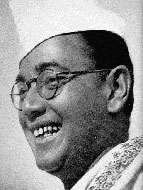
Subhash Chandra Bose
There were many great heroes born at the time of the freedom movement. Each with his own method of attaining one goal - Independence for India. Some believed in non-violent means, whereas others did not. One such hero was Subhash Chandra Bose, popularly known as 'Netaji'.
Netaji's Background
Born on January 23, 1897 in Cuttack, Orissa, to a successful lawyer Jankinath Bose and his wife Prabhavati, Netaji was of a unique temperament. His father was also chairman of the Municipal Committee and encouraged education in his province. His mother was a follower of Swami Ramakrishna Paramhansa and so inculcated spiritual values in her son. Netaji was also influenced by Swami Vivekananda.
To please his father, Netaji went to England to appear for the Indian Civil Service (I.C.S.) Examination, and achieved fourth place on the Merit list. But he had no intention of serving the British. Instead he wanted to participate in the Nationalist Movement and liberate his Motherland.
Birth of a Revolutionary
Netaji was influenced more by Lokmanya Tilak and Sri Aurobindo. He did not agree with Gandhiji's methods of achieving Independence through non-violence. Rana Pratap and Shivaji were Netaji's heroes and he believed that the only way to liberate his people was by shedding blood.
At first, Netaji joined the Congress Party and was even elected President. But because he did not agree with their views, he broke off to form the Forward Bloc. He was imprisoned for his revolutionary activities on various occasions.
Meeting with Hitler
At the time of World War II, the British were in a tight spot due to the pressure from Hitler. Netaji was under detention in Calcutta at that time, and decided to take advantage of the situation. Dressed as a Pathan, he escaped to Peshawar and then moved on to Kabul and Moscow. Next was Germany. Here he approached Hitler with his cause. Hitler was impressed and promised to help him. He then organized all the Indian Prisoners of War to form the Liberation Army and the Free Indian Army.
The Indian National Army (I.N.A.)
In 1941, Netaji went to Japan and formed the I.N.A. in 1943. 1945 witnessed the I.N.A. waging a war from the North - West of our country. He inspired his army with the battle cry 'Delhi Chalo'. Even though he did not succeed in this battle, he had driven home his message. The Britishers realised that the Indians were serious about gaining independence, and would assume any means towards that end.
On August 17, 1945, Bose died in a plane crash while flying from Bangkok to Tokyo. He did not live to see the Indian Independence, but his spirit still lives through his words - JAI HIND.
Jawaharlal Nehru
Jawaharlal Nehru
is famous for a number of reasons. He was the first Prime Minister of
India
, as well as the father of the most famous Prime Minister - Indira Gandhi. He was a patriot, a
freedom
fighter as well as a highly regarded statesman.
Early Influences
Born on 14th November 1889, to a famous lawyer of high nobility, Motilal Nehru and his wife Swaroop Rani, Jawaharlal had a good start in life. His father wanted to give him the best education possible and so sent him to Harrow, a boarding school in England, in 1905. Harrow was famous for educating most of the to be Prime ministers of England.
Nehru then went on to get his M.A. degree from
Cambridge University
and returned to
India
as a barrister. In 1916, he married Kamala Kaul, who supported his patriotism and was a devoted wife in all respects.
Fate Had Other Things In Store
Even though he had a brilliant academic record, the legal profession did not attract him. Instead, he wanted to join the
freedom
struggle
under the influence
of Gandhiji. For a while he was the Chairman of the Allahabad Municipal Committee as a member of the Congress and then he joined the Home Rule League established by Bal Gangadhar Tilak and Annie Besant.
During the
freedom
struggle, he courted arrest many a times, and had been jailed 14 years in all. He was elected Congress President 5 times, and it was under his influence in Lahore, that the Congress adopted complete
freedom
as its goal. In 1947, after
India
gained its independence, he was automatically elected first Prime Minister.
As India's First Prime Minister
He headed the Indian government for 17 long and brilliant years. He wanted
India
to develop into a world - recognised nation. He supported technological and scientific progress and encouraged art and literature. He wanted to eliminate discrimination from the face of the world and encouraged peaceful co-existence. Nehru did not believe in aligning himself with the military political blocks and wanted to end the cold war. He was awarded the Bharat Ratna in 1955.
Nehru as a Personality
Not only was he a brilliant orator, a charming, warm and noble thinker and philosopher, but also a fantastic writer. He has written a few wonderful books 'Discovery of India', 'Glimpses of World History' and ' Letters from a father to a daughter''.
On May 27, 1964,
India
lost a great influence. In the words of Dr. Radhakrishnan "As a fighter for
freedom
he was illustrious as a maker of a modern
India
, his services were unparalleled. His life and works have had a profound influence on our mental make-up, social structure and intellectual development."
Older Posts
Home
Subscribe to:
Comments (Atom)
ads
online marketing